

.svg)
Talent Acquisition & Onboarding
Set your new hires up for success





Set your new hires up for success

Build high-performing cross-cultural teams

Enhance global team collaboration

Accelerate collaboration across borders

Sync up your global teams

Make healthcare work for everyone


Today I read Matt Hardy's article Your AI content sounds right. That's exactly the problem.
At first I nearly abandoned it after the first sentence. Not because it was bad. A little bit because I thought I already knew the story. But mostly because I'm being consumed by content these days and have become ruthlessly selective.
I remember reading about machine translation in the 1990s. Back then there was a longstanding joke that a computer translated "out of sight, out of mind" into Russian and back again and produced "invisible maniac". Everyone found this reassuring. The machines were clearly idiots.
Actually, before I disappear entirely down the memory lane rabbit hole, I should probably tell you what Matt's article was about. This is a bad habit of mine. I get excited by a thought, sprint off after it and only then realise maybe the readers need some context.
So, briefly, Matt Hardy is SVP of Product at RWS, a company that specialises in language, translation and localisation technologies. His article explores a challenge that many organisations are starting to encounter with AI-generated content. The problem isn't that AI sounds wrong. Increasingly, it sounds right.
However, without nuanced understanding of each culture’s context the same message can land brilliantly in one market and fall completely flat in another. Matt's argument is essentially that if organisations want AI-generated content to resonate globally, cultural understanding can't simply be bolted on afterwards. Which is where I found myself nodding along. And then, unfortunately, thinking about monkeys.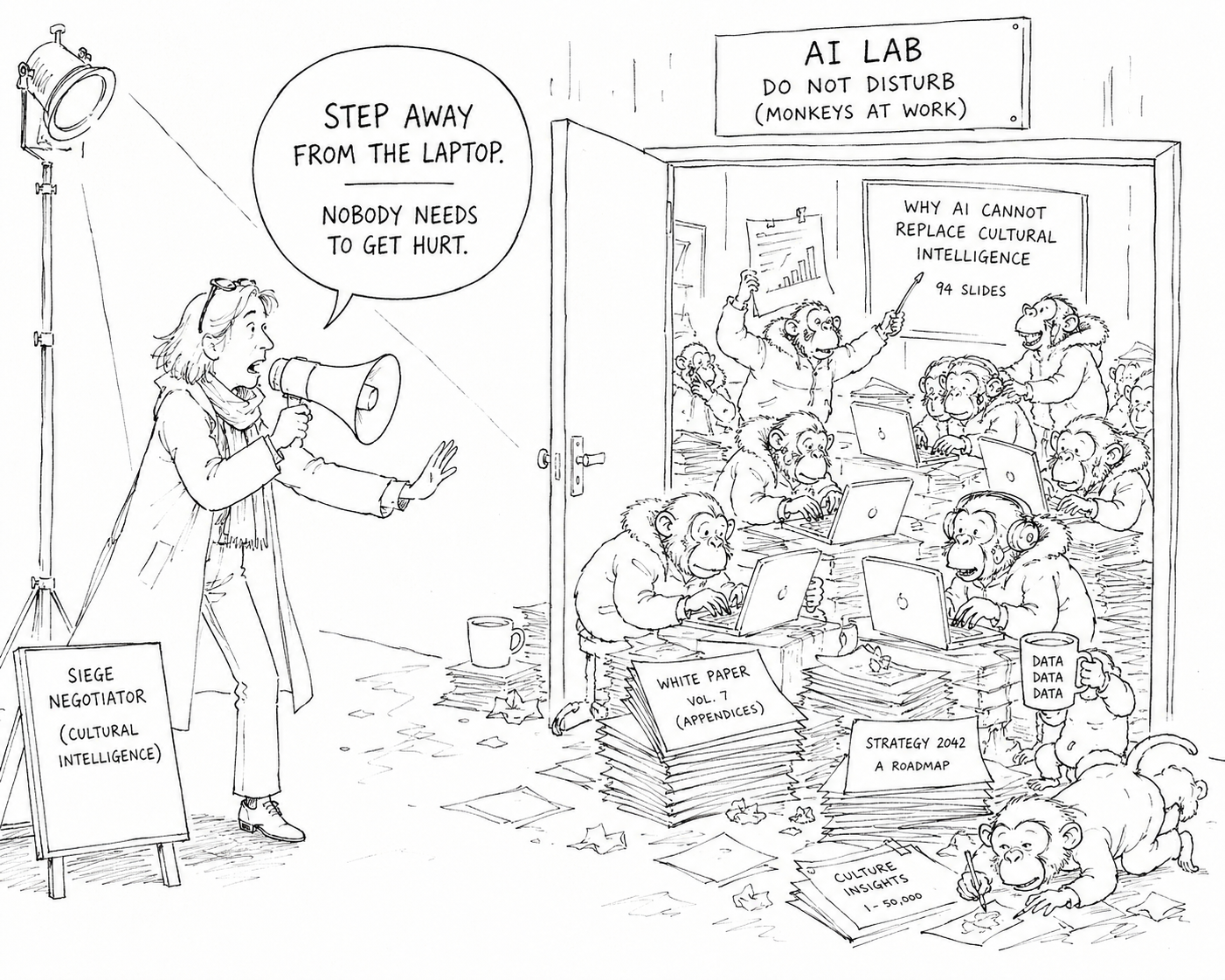
Because fast forward thirty years from machine translation jokes and clearly LLMs have moved the situation on exponentially. The machines are no longer idiots. In fact, they're alarmingly competent. They can do incredibly sophisticated things with almost no effort.
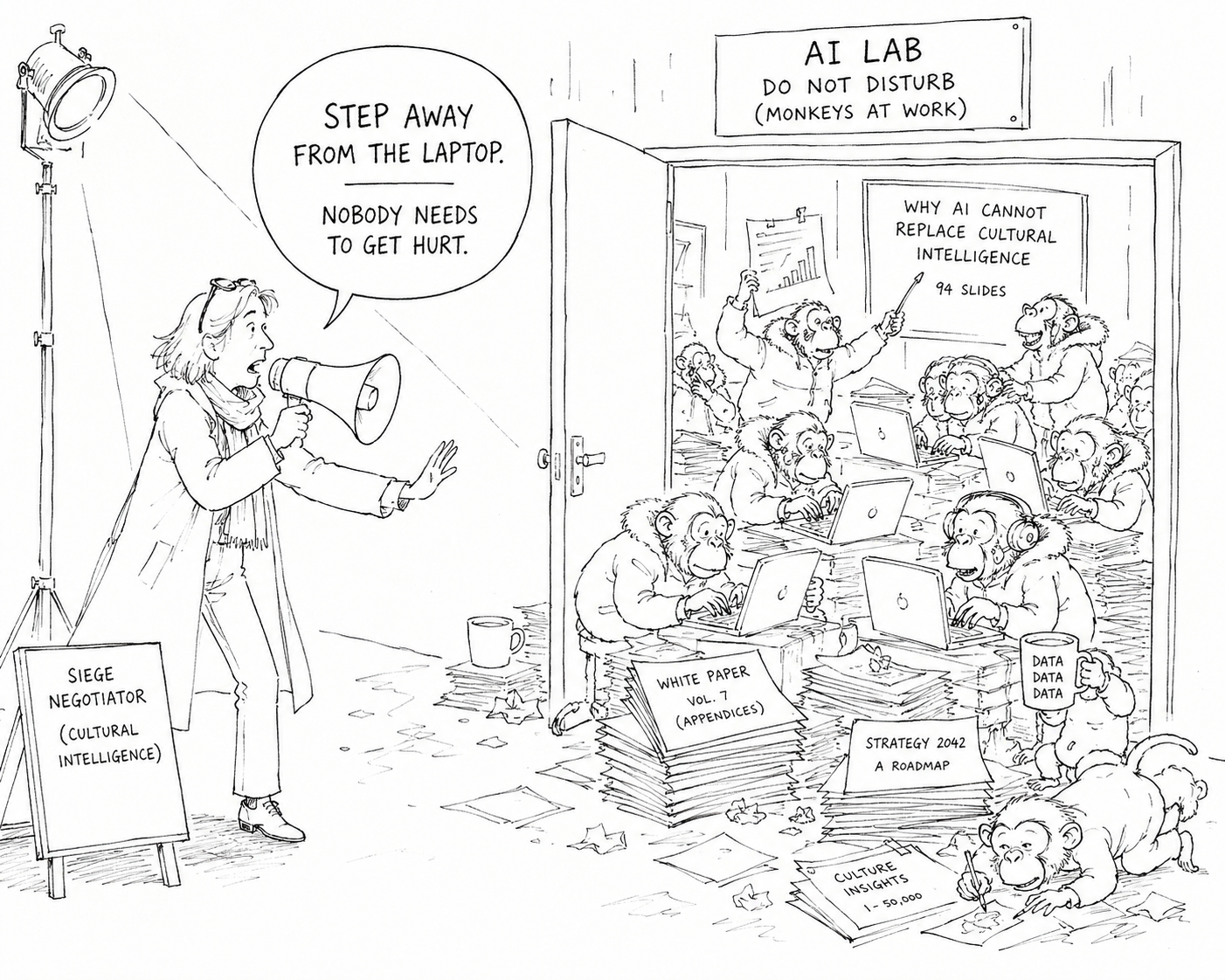
Maybe we've even reached the point, I pondered, where we can finally put those monkeys in a room with a laptop and have them re-pen the works of Shakespeare. They might even emerge more intelligent that their keepers, possibly wearing matching parkas and armed with a 40 hour keynote presentation, entitled Why AI Cannot Replace Cultural Intelligence along with a white paper, a podcast called ‘Let’s Bardify AI’ and approximately 50,000 supporting appendices. This was when my imagination got out of hand, I found myself standing in a spotlight with a megaphone negotiating with the monkeys, saying in a low but commanding voice. "Step away from the laptop. Nobody needs to get hurt."
And this was roughly the point in Matt's article where I realised we were no longer discussing invisible maniacs as a translation error. We appear to have built one. Not a dangerous invisible maniac. More a relentlessly enthusiastic one. An invisible maniac with access to every cultural insight ever written, unlimited processing power and a particular fondness for generating beautifully designed html slides. Hundreds of them.
Meanwhile, back at Country Navigator, a small group of us are attempting to hold the line. Every morning we wake up to discover the machine has generated another country guide, three learning pathways, a training course and approximately seventeen thousand new thoughts about intercultural communication. It is tireless. It is cheerful. It has no concept of enough.
The machine sees a request for ten slides and thinks:
"Excellent. I have prepared ninety."
The machine sees a request for a cultural insight and thinks:
"Excellent. I have located a legion of them."
The machine sees a gap in our knowledge and responds by filling it with several million words.
Fortunately, we have procedures for whenever this happens. The discernment SWAT team is immediately deployed with clipboards, camomile tea and, in extreme cases, tranquilliser darts. Their mission is simple: identify the twelve useful insights, separate them from the remaining forty-nine thousand nine hundred and eighty-eight, and prevent anyone from being vaporised by attempting to consume the machine's latest offering of absolutely everything. It is demanding work. The machine regards it as sabotage.
At this point I should probably mention that I grew up in the age of paper. Information used to arrive attached to physical objects: Books. Magazines. Newspapers. You could only read as fast as somebody could print. Now I can generate more words before elevenses than I have encountered in my entire life to date.
It's progress. Mostly. But it does leave a small squadron of humans standing in the middle of the Large Language Model battlefield wondering what exactly we're supposed to do with all this material. Because here's the thing. The machine has largely solved production. What it hasn't solved is discernment.
It can tell us everything. It cannot tell us what matters. It can generate the course. It cannot tell us which three slides people will remember. It can surface thousands of cultural observations. It cannot tell us which one will change somebody's mind.
Matt wants the machine to preserve linguistic nuance and meaning across translations. I'm wondering whether people can keep up with the machine. Perhaps what we really need is containment. Not because the beast is dangerous. Because the beast is enthusiastic.
The beast appears to have consumed six espressos, discovered cultural intelligence and gained unrestricted access to the internet. Someone, somewhere, may eventually need to build a cage. Or at the very least a gatekeeper with the authority to say:
"No."
"We don't need another 40-page report."
"Twenty insights will do."
"Three examples are enough."
"Please stop making slides."
Until then, we remain at our posts. A small division of humans armed with judgement, red pens and an increasingly powerful sense that comprehensive and comprehensible are not the same thing. The machines may have won the battle for production. We're hoping to retain control of meaning.
Here's where I get the monkeys to look up from the magnetic enthusiasm of the invisible maniac and start negotiations. I don't need to slow them down. I just want to get ahead of the discernment wave. To decide what matters before generating fifty thousand examples of anything.
To start with expertise rather than hoping to discover it afterwards. To let humans lead and AI follow. In many ways, that's exactly what we're trying to do with Carla. If you're curious about what AI built with CQ looks like, it doesn't begin with a language model. It begins with decades of cultural expertise and asks a different question: How can AI make this easier to access, apply and scale?
The beast generates first and asks questions later. We're trying to ask the questions first.

GET STRATEGIC INSIGHTS DRIVING ENTERPRISE GROWTH WORLDWIDE.
Join companies already using Country Navigator


COMMENTS