

.svg)
Worldprism™
A 45 question cultural assessment

A 45 question cultural assessment

Insights for 100+ countries

AI Scenario practice and CultureFlex scoring


All 32 modules, filterable by skill, audience and format

Become a globally recognized CQ Coach with the Worldprism program

Set your new hires up for success

Build high-performing cross-cultural teams

Enhance global team collaboration

Accelerate collaboration across borders

Sync up your global teams

Make healthcare work for everyone

Empower students, faculty, and staff


The numbers tell a sobering story. In 2025, 87% of mobility professionals view workforce mobility as critical for talent development, and 76% link it directly to retention rates. Yet despite these acknowledged connections, an overwhelming 90% of employers believe there are benefits in aligning mobility with broader organizational and talent goals, but 70% of this group has been unable to achieve such results.
The gap between intention and execution is costing organizations millions in failed assignments, lost productivity, and missed leadership opportunities. More importantly, it's costing talented employees the career development they were promised when they accepted that international role.

Most organizations invest significant resources into their talent pipelines, carefully aligning skill development with future business needs. Then they send high-potential employees on international assignments and hope for the best. An assignment can develop your talent and can give them cultural intelligence, but there is nothing automatic about it.
Leadership skills develop more quickly, more deeply and more effectively through living and working in another country. The experience forces people to navigate unfamiliar business environments, build relationships across cultural boundaries, and develop the adaptability that defines effective global leaders. Research shows that 80% of respondents said taking an expat assignment had a positive impact on their career. But the potential for growth doesn't guarantee it will happen.
Without intentional planning and support, that expensive international assignment becomes just an expensive international assignment. Assignees can return home with reinforced biases rather than expanded perspectives, frustrated rather than energized, and sometimes not at all because they've accepted an offer elsewhere.
When organizations focus exclusively on compliance, immigration paperwork, and housing logistics, they overlook the factor that determines whether an assignment succeeds or fails: cultural intelligence.
In the struggle to organize the compliance, tax, insurance, immigration and customs documentation, finding house and school, handing over one role to start a new one, it's easy to overlook the fact that there is a cultural challenge that could limit the success of the assignment.
Cultural intelligence is the capability to work effectively across different cultural contexts. It's what enables an assignee to build trust with local colleagues, navigate decision-making processes that differ from home, and adapt their leadership style to what works in the host location. It's also what separates leaders who can operate anywhere from those who can only succeed in familiar environments.
This is where Country Navigator's approach transforms traditional global mobility support. Rather than treating cultural preparation as a pre-departure checkbox, the platform provides ongoing tools that assignees need throughout their journey.

Turning global assignments into leadership pipelines requires more than good intentions. It requires a structured approach that treats international experience as intentional development, not incidental learning.
Organizations need to start by asking critical questions. Which leadership competencies (e.g., cultural agility, adaptability, strategic thinking) can be strengthened through global experiences? What types of assignments foster the capabilities needed for future roles? How can mobility programs be designed to maximize leadership learning?
Country Navigator helps answer these questions through three integrated tools that support assignees before, during, and after their international experience:
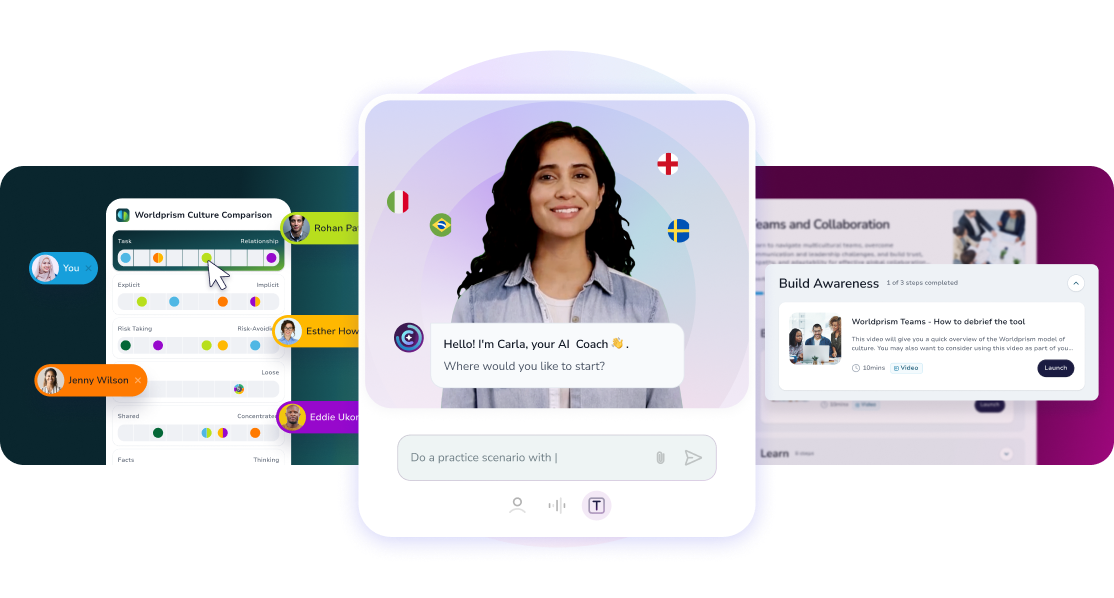
Country Navigator's Worldprism™ Assessment provides the foundation. Built on over 30 years of research and validated by more than 200 cultural experts, this personal cultural assessment helps individuals understand their own cultural preferences across nine dimensions. An assignee discovers whether they tend toward direct or indirect communication, whether they prefer structured or flexible time management, and how their decision-making style compares to colleagues in their host country.
This self-awareness is crucial. You can't adapt your approach if you don't understand what your natural approach is in the first place. The assessment gives assignees a clear picture of where they'll find natural alignment with their new environment and where they'll need to consciously flex their behavior.
CultureFlex takes that understanding and builds practical skills. This scenario-based practice tool presents real situations assignees might encounter in their host location. Should you challenge your manager's decision in a team meeting? How do you give constructive feedback to a direct report in this culture? What's the appropriate way to build relationships with new colleagues?
Users select their context, work through scenarios, and receive instant feedback with scoring. The tool measures their ability to analyze cultural situations, decide on appropriate strategies, and execute effectively. It's practice in a safe environment before the stakes are real.
Carla, the AI Culture Coach, provides personalized guidance exactly when it's needed. Carla uses Country Navigator's proprietary award-winning content, enriched by insights from over 200 cultural experts and trainers. She offers personalized, unbiased, and stereotype-free guidance, helping you work better with colleagues from around the world.
An assignee can ask Carla specific questions about their situation and receive immediate, contextually relevant advice. The responses are customized based on the user's Worldprism™ profile. For example, you might ask Carla: "Since my Worldprism™ profile suggests I prefer open and direct communication, how should I adapt my communication style for better teamwork with my colleagues in Japan?
Carla doesn't just provide generic cultural information. Carla helps users understand when to adapt their approach to match others, when to seek middle ground through blending, how to co-create new approaches with colleagues from different cultures, when adaptation might not be appropriate, and how to maintain necessary standards while respecting cultural differences at any time of day. Even at 2AM.
The most critical phase of talent development through global mobility often receives the least attention: what happens when the assignee returns home. We frequently hear stories of assignees who feel forgotten, some of whom return to their home country to some made-time work, because no one thought what to do with them when their assignment ended.
Organizations need intentional reintegration strategies. The skills an assignee develops abroad are valuable, but only if the organization creates space to use them. Having invested large sums in developing your talent, you need to show that there is an intentional and thought-through career progression beyond the assignment. This means regular check-ins throughout the assignment, not just at the beginning and end. Without regular check-ins, you could either end up with a disillusioned employee with the wrong skills, or with a letter of resignation. Frequent conversations ensure that development stays aligned with evolving business needs and that assignees feel valued rather than forgotten.
It also means measuring the right outcomes. Establish leadership KPIs such as cross-cultural effectiveness, global business acumen, and strategic decision-making. Track how international experience enhances leadership capabilities. Document the competencies gained. Create clear pathways for returning assignees to apply their expanded skills in roles with greater responsibility.
The organisations that succeed in 2025 and beyond will be the ones that treat mobility not as admin but as a competitive advantage. When done strategically, global assignments create leaders who can operate effectively anywhere, teams that understand diverse markets firsthand, and organizations with the agility to deploy talent where it's needed most.
Country Navigator's Global Mobility pathways address the challenges of talent mobility, current and future. We help prepare individuals, families, and organizations for successful assignments in over 160 countries around the world. The platform's integrated approach ensures that cultural intelligence development isn't separate from the assignment experience. It's woven throughout the journey, from pre-departure preparation through ongoing support to reintegration planning.
Organizations using Country Navigator's tools can also access comprehensive Country Guides with detailed profiles on over 100 countries, customizable Learning Pathways for specific development needs, and detailed Reporting that provides insights to guide training strategies and measure progress.
For teams that need additional support, Country Navigator offers Live Coaching with certified cultural intelligence experts who can deliver bespoke workshops, masterclasses, or one-on-one coaching sessions tailored to specific challenges.
Transforming global assignments into strategic talent pipelines requires a fundamental shift in how organizations approach international mobility. It means moving from a compliance mindset to a development mindset. It means treating cultural intelligence as a core competency, not a soft skill. And it means providing ongoing support that helps assignees develop the capabilities they need to become effective global leaders.
The investment in strategic mobility pays dividends that extend far beyond individual assignments. Innovation, problem-solving, making good decisions, agility, and making sense of complexity are all key skills a leader needs. And they're all skills that come with the experience of leading in different country contexts.
Those skills don't develop by accident. They develop when organizations commit to building global mobility programs with intentional talent development at their core, supported by tools that make cultural intelligence accessible, practical, and measurable.
Country Navigator provides the platform, assessments, AI coaching, and expert support that make this transformation possible. Built on 30 years of research and trusted by over 1 million professionals across 64 countries, it's helping organizations turn their international assignments from expensive relocations into strategic investments in leadership capability.
The question isn't whether global assignments can develop future leaders. The question is whether your organization is set up to make it happen.
At Country Navigator, we help organizations develop the cultural intelligence their teams need to thrive in global environments. Because in an increasingly connected world, the ability to work effectively across cultures isn't just an advantage. It's essential. With more than 30 years of experience supporting over one million people globally, we are committed to driving meaningful change. Ready to scale without stumbling? Speak to us today.

GET STRATEGIC INSIGHTS DRIVING ENTERPRISE GROWTH WORLDWIDE.
Join companies already using Country Navigator






COMMENTS