
.svg)
Worldprism™
A 45 question cultural assessment

A 45 question cultural assessment

Insights for 100+ countries

AI Scenario practice and CultureFlex scoring


For up to 500 people 60-90 mins

For up to 24 people 2-8 hours, live or virtual
For 1:1 development that's personalized


Set your new hires up for success

Build high-performing cross-cultural teams

Enhance global team collaboration

Accelerate collaboration across borders

Sync up your global teams

Make healthcare work for everyone

Empower students, faculty, and staff











Most CQ programs measure engagement rather than skill. Learners complete modules, attend sessions and fill out surveys, but L&D teams are left without a standard to measure against and without data to bring to the board.
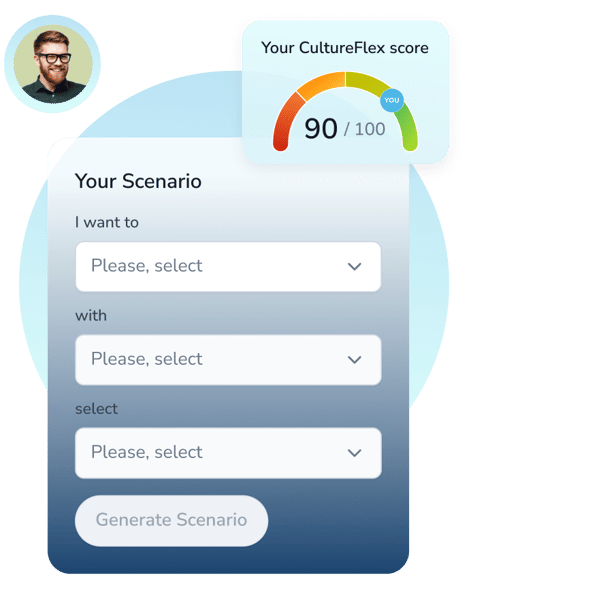
The CultureFlex Skills Framework fixes this. It breaks cultural intelligence into 13 specific, scorable skills, each with a clear definition, four proficiency level descriptors and a score from 0 to 100 generated by AI Simulations. L&D teams can set targets, track progress and show real impact.

The foundational mindset of openness, curiosity and non-judgement towards cultural difference. It is the prerequisite for developing the applied skills.
Scored at Aware, Practicing, Proficient, or Strategic
The ability to notice and read cultural signals accurately in communication, behavior and context, including awareness of one's own cultural defaults.
Scored at Aware, Practicing, Proficient, or Strategic
Working knowledge of the Worldprism™ dimensions, country cultural profiles, and how specific cultural norms shape behavior in the learner's key contexts.
Scored at Aware, Practicing, Proficient, or Strategic
Learners complete the 45-question Worldprism™ assessment, which maps their cultural default across 9 dimensions and sets the starting context CultureFlex scores against.
Learners apply the 13 skills inside realistic, AI-driven scenarios. Each CultureFlex simulation scores behavior against the skill definitions, rather than relying on self-report or a quiz.
Each skill resolves to a score from 0 to 100 and a proficiency level from Aware to Strategic. These roll up into an overall CultureFlex score that L&D teams can track, target and report on.
BOOK A DEMO AND WE'LL SHOW YOU WHAT CULTUREFLEX™ SCORING LOOKS LIKE AND HOW THE DATA MAPS TO YOUR L&D GOALS.

Join companies already using Country Navigator